– Isaiah 53:10
Have you ever done something you didn’t really want to do? I grew up with three siblings and there were many things I was made to do that I didn’t want to do. I am sure you can relate in one way or another. Maybe it was a chore you needed to get done; or an assignment you had to complete for school; or even a job you once had that you disliked but kept anyway. When we apply this human condition to Jesus, who was fully human but also fully God, this falls short. If you are new to Christianity, or are unfamiliar with the church’s tradition this time of year, Holy Week is the Christian observance commemorating the series of events that took place in the final week of Christ’s earthly ministry. This begins on Palm Sunday and culminates in his death and resurrection on Easter Sunday. As Christians, we believe that Christ came to rescue us from the power of sin and death, and to reconcile us to the Father (Rom. 5:8, 2 Cor. 5:18-19, 21). When a person reflects on the events that occurred during Holy Week, one might ask, “Did Jesus really have to die?” Ultimately, Christ did not have to do this, but as part of the plan of the Godhead from eternity past, he willingly chose to do so in order that we might share in the loving communion between the Father, Son and Holy Spirit. Jesus came because of God’s love (Jn 3:16), and he chose to empty himself for our sake (Phil. 2:5-11).
Below is a summary of the events that took place before Easter Sunday. I will encourage you to read the gospel accounts for greater context.
Palm Sunday: Jesus enters Jerusalem
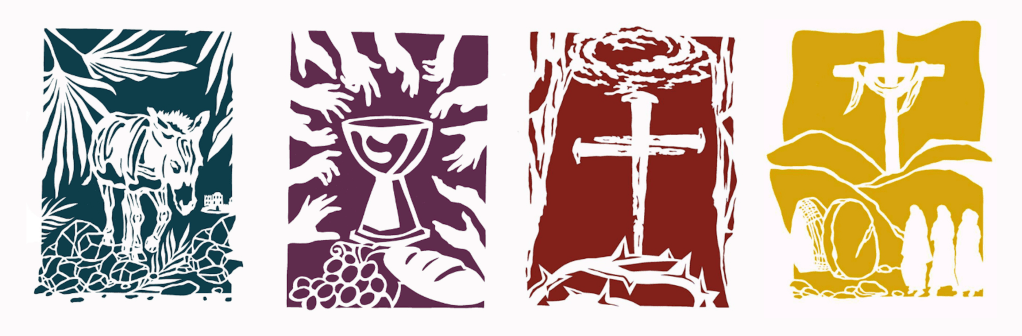
On the Sunday before his crucifixion, Jesus started his journey to Jerusalem, understanding that he would be killed there for the sins of humanity. Close to the village of Bethphage, he sent two of his disciples forward, telling them to find a donkey and its untamed colt. The disciples were instructed to untie the animal and bring it to him. Then Jesus sat on the young donkey and gently made his celebrated entry into Jerusalem, accomplishing the biblical prophecy in Zechariah 9:9. The crowds there greeted him by waving palm branches and yelling, “Hosanna to the Son of David! Blessed is he who comes in the name of the Lord! Hosanna in the highest!” (Matt. 21:9). On the evening of Palm Sunday, Jesus and his disciples went to Bethany, a town roughly two miles east of Jerusalem. This is where Lazarus, whom Jesus had raised from the dead, and his two sisters, Mary and Martha, resided. They were dear friends of Jesus and likely hosted Christ and His disciples during their final days in Jerusalem. The Bible account of Palm Sunday is found in Matthew 21:1-11, Mark 11:1-11, Luke 19:28-44, and John 12:12-19.
Holy Monday: Jesus at the Temple & the Cursed Fig Tree
The following morning, Jesus returned with his disciples to Jerusalem. Along the way, he cursed a fig tree because it had failed to bear fruit. Some scholars consider this cursing of the fig tree to symbolize God’s judgment on Israel’s spiritually dead religious leaders. Others believe the analogy reached to all believers, explaining that true faith is more than just outward religiosity; true, living faith must bear spiritual fruit in a person’s life. When Jesus appeared at the Temple, he discovered the courts full of corrupt money changers. He overturned their tables and cleared the Temple, saying, “The Scriptures declare, ‘My Temple will be a house of prayer,’ but you have turned it into a den of thieves” (Lk. 19:46). On Monday evening, Jesus stayed in Bethany again, likely in the home of his friends Mary, Martha, and Lazarus. This is where Mary anoints the feet of Jesus. The Bible account of Holy Monday is found in Matthew 21:12-22, Mark 11:15-19, Luke 19:45-48, and John 2:13-17.
Holy Tuesday: Jesus Goes to the Mount of Olives
On Tuesday morning, Jesus and his disciples returned to Jerusalem. At the Temple, Jewish religious leaders were enraged at Jesus for establishing himself as a spiritual authority. They arranged an ambush with the intent to arrest him. But Jesus eluded their traps and declared severe judgments on them, saying: “Blind guides!…For you are like whitewashed tombs—beautiful on the outside but filled on the inside with dead people’s bones and all sorts of impurity. Outwardly you look like righteous people, but inwardly your hearts are filled with hypocrisy and lawlessness…Snakes! Sons of vipers! How will you escape the judgment of hell?” (Matt. 23:24-33). Later that day, Jesus left Jerusalem and went with his disciples to the Mount of Olives, which overlooks the city. There Jesus delivered the Olivet Discourse, an extensive revelation about the destruction of Jerusalem and the end of the age. He speaks, as usual, in parables, using symbolic language about the end times events, including his Second Coming and the final judgment. The Bible account of Holy Tuesday and the Olivet Discourse is found in Matthew 24, Mark 13, and Luke 21.
Holy Wednesday: Judas agrees to betray Christ
Although scripture doesn’t affirm what the Lord did on Holy Wednesday, theologians consider that after two days in Jerusalem, Jesus and his disciples used this day to rest in Bethany in expectation of Passover. It is traditionally believed that Judas agreed to betray Jesus on the Wednesday before Easter Sunday. “Then one of the Twelve—the one called Judas Iscariot—went to the chief priests and asked, “What are you willing to give me if I deliver him over to you?” So, they counted out for him thirty pieces of silver. From then on Judas watched for an opportunity to hand him over.” (Matt. 26:14-16).
“Now the Festival of Unleavened Bread, called the Passover, was approaching, and the chief priests and the teachers of the law were looking for some way to get rid of Jesus, for they were afraid of the people. Then Satan entered Judas, called Iscariot, one of the Twelve. And Judas went to the chief priests and the officers of the temple guard and discussed with them how he might betray Jesus. They were delighted and agreed to give him money.” (Lk. 22:1-5).
Maundy Thursday: Passover and the Last Supper
On the Thursday of Holy Week, Jesus washed his disciples’ feet as they prepared to share in the Passover. By doing this humble act of service, Jesus showed by example how his followers should love one another. Today, many churches follow foot-washing commemorations as a component of their Maundy Thursday worship services. Then, Jesus bestowed the feast of Passover, also known as the Last Supper, with his disciples, stating: “I have earnestly desired to eat this Passover with you before I suffer. For I tell you I will not eat it until it is fulfilled in the kingdom of God.” (Lk. 22:15-16). As the Lamb of God, Jesus fulfilled Passover’s purpose by giving his body to be broken and his blood to be shed in sacrifice, saving us from sin and death. During this Last Supper, Jesus established the Lord’s Supper, or Communion, teaching his disciples to continuously recognize his sacrifice by sharing in the bread and wine. “And he took bread, and when he had given thanks, he broke it and gave it to them, saying, “This is my body, which is given for you. Do this in remembrance of me.” And likewise the cup after they had eaten, saying, “This cup that is poured out for you is the new covenant in my blood.” (Lk. 22:19-20).
After the meal, Jesus and the disciples left the Upper Room and went to the Garden of Gethsemane, where Jesus prayed in anguish to God the Father. The book of Luke states that “his sweat became like great drops of blood falling down to the ground” (Lk. 22:44). Late that night in Gethsemane, Jesus was betrayed with a kiss by Judas Iscariot and arrested by the Sanhedrin. He was taken to the house of Caiaphas, the High Priest, where the full council had assembled to make their claim against Jesus. In the early morning, as Jesus’ trial was beginning, Peter denied knowing his Master three times before the rooster crowed. The Bible account of Maundy Thursday is found in Matthew 26:17-75, Mark 14:12-72, Luke 22:7-62, and John 13:1-38.
Good Friday: Jesus’ Trial, Crucifixion, Death, and Burial
According to the Bible, Judas Iscariot, the disciple who had betrayed Jesus, was overwhelmed with guilt and hanged himself early Friday morning. Jesus suffered the shame of false accusations, rebukes, ridicule, whippings, and abandonment. After various unlawful trials, he was condemned to death by crucifixion, one of the most painful and disgraceful practices of capital punishment known at the time. Before Christ was led away, soldiers pierced him with a crown of thorns while mocking Him as “King of the Jews.” Then Jesus carried his crucifixion cross to Calvary where he again was mocked and defamed as Roman soldiers nailed him to the wooden cross. Jesus delivered seven final remarks from the cross. His first words were, “Father, forgive them, for they know not what they do.” (Lk. 23:34). His last words were, “Father, into your hands I commit my spirit!” (Lk. 23:46). By Friday evening, Nicodemus and Joseph of Arimathea had taken Jesus’ body down from the cross and laid it in a tomb. The Bible account of Good Friday is found in Matthew 27:1-62, Mark 15:1-47, Luke 22:63, 23:56, and John 18:28; 19:37.
Holy Saturday: Christ in the Tomb
The body of Jesus was laid in its tomb, where it was watched by Roman soldiers during the day on Saturday, the Sabbath. At the end of Holy Saturday, Christ’s body was ceremonially treated for burial with spices bought by Nicodemus: “Nicodemus also, who earlier had come to Jesus by night, came bringing a mixture of myrrh and aloes, about seventy-five pounds in weight. So they took the body of Jesus and bound it in linen cloths with the spices, as is the burial custom of the Jews.” (Jn. 19:39-40). Like Joseph of Arimathea, Nicodemus was a member of the Sanhedrin, the Jewish court that had denounced Jesus Christ to death. For a time, both men had lived as unknown followers of Jesus, scared to make a public declaration of faith because of their notable positions in the Jewish community. Likewise, both were genuinely affected by Christ’s death. They bravely came out of hiding, endangering their prestige and their lives, recognizing that Jesus was, in fact, the long-awaited Messiah. Together they cared for Jesus’ body and prepared it for burial. As his physical body lay in the tomb, Jesus Christ paid the penalty for sin by giving the perfect sacrifice (Heb. 10:14). He conquered death, both spiritually and physically, securing our eternal salvation: “Knowing that you were ransomed from the futile ways inherited from your forefathers, not with perishable things such as silver or gold, but with the precious blood of Christ, like that of a lamb without blemish or spot.” (1 Pet. 1:18-19). The Bible account of Holy Saturday is found in Matthew 27:62-66, Mark 16:1, Luke 23:56, and John 19:40.
Easter Sunday: Jesus rises from the dead! (see next post)
In highlighting God’s sovereign control of the events of Holy Week, R.C. Sproul said, “What happened on Good Friday was not an accident. Rather, it had been determined in the sovereign plan of God from the foundation of the world.” What great joy it is to serve a God who is fully in control at all times. One might rightly ask, why was the darkest, gloomiest, and saddest day in history called “good”? Well, those of us who are on this side of the cross have a better vantage point and understanding. Namely, because we know what happened three days later. A word of encouragement to you in this season: Friday is only good because Sunday is coming. Don’t lose hope, because Sunday is coming!!! So, what are you waiting for? Today is the day to put your trust in Jesus and his finished work on the cross. This is the only way that God allows people into heaven, in order that they might enjoy him forever. Trust in his Son through faith alone, and nothing else (Jn 3:16, Eph. 2:8-10). Will you accept this Good News and rest in it for the remainder of your life?
 Drink from The Well
Leave a comment