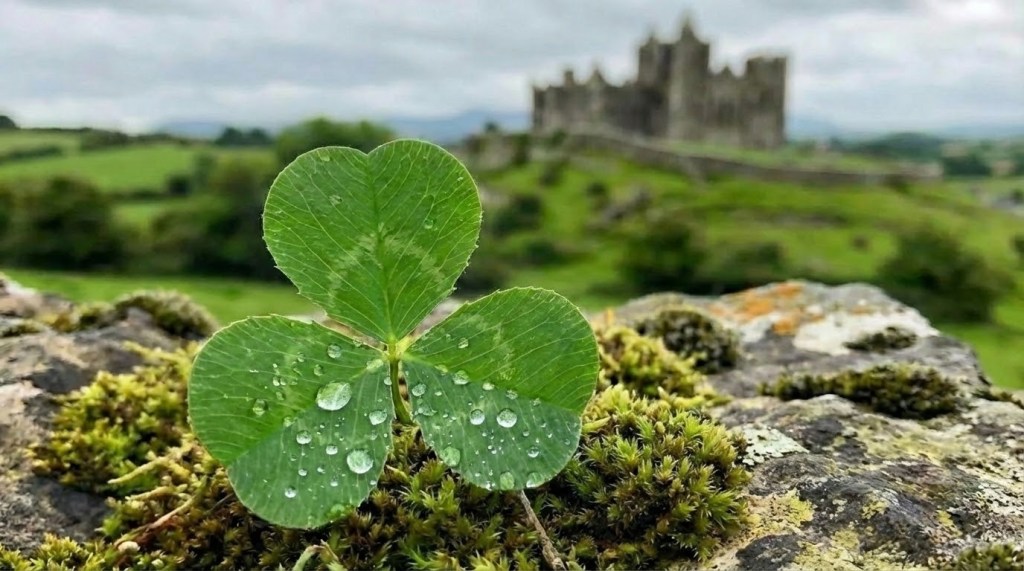
The iconic image associated with St. Patrick’s Day is the shamrock, a simple three-leafed clover. Legend tells us that Patrick used this humble plant as an attempt to explain the profound mystery of the Christian Trinity—one God existing in three persons: Father, Son, and Holy Spirit. This botanical lesson served as a powerful metaphor to a pagan people, a first step in a life dedicated to introducing Ireland to the living God. Yet, as the commercialized celebration of March 17th washes the world in green, parades, and pints, the true story of the man—the missionary, the captive, the saint—is often obscured. Patrick’s life was not a celebration; it was a mission.
From Captive to Convert.
Patrick, originally named Maewyn Succat, was not Irish. He was born in Roman Britain in the late 4th century. His early life was one of privilege, but at the age of sixteen, his world shattered. Irish raiders kidnapped him and transported him across the sea to serve as a slave, tending sheep in the harsh hills of Ireland. This period of forced isolation and suffering became the crucible of his faith. Though his family was nominally Christian, it was in the desolate fields that Patrick truly encountered God. In his autobiographical work, the Confessio, he wrote of this transformation: “And there the Lord opened the sense of my unbelief that I might at last remember my sins and be converted with all my heart to the Lord my God, who had regard for my insignificance and pitied my youth and ignorance.” He spent six years in captivity, sustained by prayer, often reciting prayers hundreds of times a day. This deep spiritual discipline, born out of desperation, illustrates the principle found in Romans 12:12: “Be joyful in hope, patient in affliction, faithful in prayer.”
The Call to Return.
After six years, Patrick escaped, guided by what he believed was a “divine voice.” He made his way back to Britain and his relieved family. He studied for the priesthood, but his peace was temporary. A vision compelled him to return to the very land of his enslavement. He heard the “voice of the Irish” calling to him: “We beg you, holy youth, that you should come and walk again among us.” This call was a radical act of forgiveness and obedience. Rather than nursing the bitterness of his slavery, Patrick embraced a mission to reconcile his former captors to Christ. He willingly exchanged the safety of home for a life of danger among the people who had wronged him. His motivation was rooted in the Great Commission, given by Christ in Matthew 28:19–20: “Therefore go and make disciples of all nations, baptizing them in the name of the Father and of the Son and of the Holy Spirit, and teaching them to obey everything I have commanded you.”
A Dangerous Mission Field.
Patrick’s missionary work was tireless and often dangerous. He traveled throughout Ireland, preaching the Gospel, confronting Druidism, and baptizing many. He established churches, ordained priests, and founded monasteries. He understood that faith sometimes requires a public stand. He faced opposition from tribal kings, endured arrests, and narrowly escaped death multiple times. He even challenged the slave trade, writing an open letter condemning the actions of a British tyrant who had enslaved Irish converts. Patrick’s steadfastness in the face of adversity echoes the conviction of the Apostle Paul in 2 Timothy 4:2: “Preach the word; be prepared in season and out of season; correct, rebuke, and encourage—with great patience and careful instruction.” His entire life was a testimony to what the love of Christ compels one to do: return good for evil and share the Good News with courage.
Living a Life On Mission.
Saint Patrick’s life serves as a powerful antidote to the secularization of “his holiday.” He was not a transmitter of luck or a symbol for festivities; he was a man exclusively surrendered to a divine purpose. His true legacy is the complete transformation of a nation through the Gospel. For Christians today, Patrick’s story is not merely historical trivia; it is an urgent exhortation. We are all called to be “saints on mission.” This calling doesn’t necessarily mean moving to a distant land, but it does mean living intentionally as ambassadors for Christ where we are—in our workplaces, our homes, and our communities.
- Identify your Ireland: What is the place, the relationship, or the sphere of influence where you have experienced hardship, rejection, or struggle? Like Patrick, can you view that place not as a trauma to avoid, but as a mission field where God has positioned you for purpose?
- Embrace the cost: Mission is rarely convenient or comfortable. It demands self-denial and courage. Jesus reminded his followers in Luke 9:23: “Whoever wants to be my disciple must deny themselves and take up their cross daily and follow me.”
- Rely on prayer: Patrick’s faith matured through prayer while he was a shepherd. Our mission must be fueled by constant communion with God—through prayer (and His word). Without this spiritual root, our efforts will be fruitless.
This Saint Patrick’s Day, as the world celebrates the folklore, let us remember the truth: a life surrendered to God and his mission is the greatest life of all. Let the shamrock remind us of the triune God we serve, and let Patrick’s journey inspire us to live out our faith with the same passion, courage, and unconditional love that transformed a pagan land. The mission continues; will you join in?
Isaiah 6 (Here am I Send Me) by Lindy Conant & The Circuit Riders
 Drink from The Well
Leave a comment