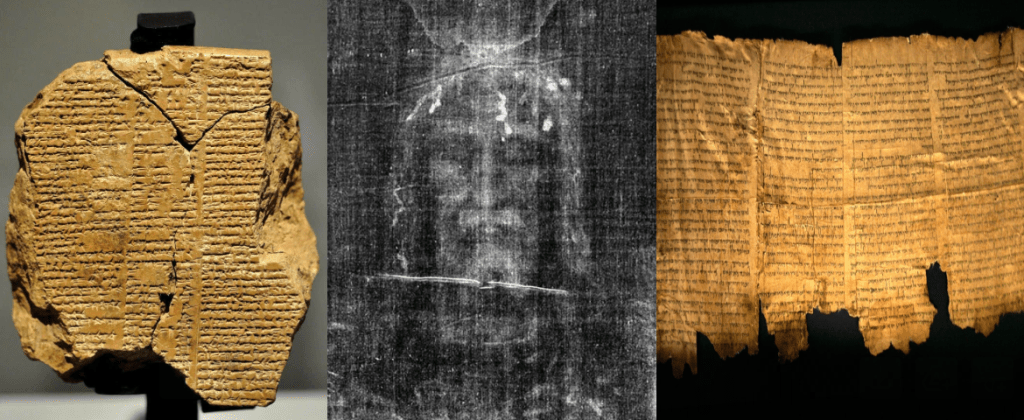
My friends and I recently spent some time at the Museum of the Bible in Washington D.C. It’s an incredible place, showcasing the history, impact, and narrative of the Scriptures. But as we moved through the exhibits, I noticed something interesting. Some of us were, naturally, drawn to the oldest, most physically tangible items: fragments of ancient papyri, copies of massive stone tablets, and replicas of first-century artifacts. We spent a good amount of time examining videos and marveling at the amazing contributions to the faith over the years.
The irony wasn’t lost on me. Here we were, surrounded by copies of Bibles in different languages, all testifying to the living and active Word of God (Heb. 4:12), yet our attention was often captivated by the “extra-biblical.” We were chasing riddles and relics, drawn in by the mystique and the physical evidence of what is, fundamentally, a faith based on revelation. This experience brought a challenge to mind: Why are we so often more fascinated by the things surrounding the Bible—the potential rubbish of history and legend—than by the sufficiency of the Scriptures (2 Tim. 3:16-17) themselves?
The Allure of the Artifact.
It’s human nature to want physical proof. We crave the concrete, the touchable, the measurable. In fact, one of Jesus’ disciples, Thomas, also known as “doubting Thomas,” wanted to physically see and touch him in order to believe he was risen from the dead. In a sense I don’t blame him, because we too can be just like Thomas at times—but that doesn’t faze God. And in his divine providence, God even allowed the risen Jesus to physically appear to over 500 people after his resurrection (1 Cor. 15:6).
Consider the Shroud of Turin, housed in Italy, which offers a medical and historical puzzle. Or the various pieces of the “True Cross” supposedly scattered in churches and monasteries around the world, offering a supposed direct, physical connection to the moment of salvation. These artifacts fuel a persuasive mixture of religious devotion, historical curiosity, and scientific investigation. However, this curiosity can quickly become a spiritual danger. When we rely on relics or artifacts as supplementary “evidence” for Christianity, we mistakenly imply that God’s chosen method of revelation—His Word—is insufficient. We move beyond the boundaries God has set, seeking validation in the dust of history rather than in the divine breath that inspired the Scriptures.
The Apostle Peter speaks pointedly to the sufficiency of God’s revealed Word: “His divine power has granted to us all things that pertain to life and godliness, through the knowledge of him who called us to his own glory and excellence, by which he has granted to us his precious and very great promises, so that through them you may become partakers of the divine nature, having escaped from the corruption that is in the world because of sinful desire.” (2 Peter 1:3–4) All things that pertain to life and godliness. Not “all things, plus a verifiable relic.” The Scriptures, given through the knowledge of Christ, are fully equipped to guide us, transform us, and lead us into the fullness of the Christian life. To seek proof in relics is to question God’s provision, treating His Word as incomplete. “The law of the LORD is perfect, reviving the soul” (Psalm 19:7). Yes, God welcomes all our questions and doubts. But as we grow in our walk with him and know him better (Eph. 1:17), we come to take him at his word, being assured that he is faithful.
The Cross Was Enough.
The ultimate evidence for Christianity is not an unsolved historical riddle, but an undeniable historical event: the crucifixion and resurrection of Jesus Christ. The cross itself, though a humble piece of timber, was the sufficient proof God provided to the world. It wasn’t a puzzle to be solved centuries later by carbon dating, but the definitive, public demonstration that God came in the form of flesh (Jn. 1:14) to save the world. It was the finished work—Tetelestai—a declaration of victory that requires no supporting physical artifacts to be true. When we focus on relics, we risk turning faith into forensics. Christianity is not about finding the perfect piece of evidence to silence the skeptic; it is about faith in the living God, revealed supremely in Jesus Christ and reliably recorded in the Scriptures. The power of the Gospel doesn’t rest in the thread count of a burial cloth but in the glorious reality that “Christ died for our sins in accordance with the Scriptures, that he was buried, that he was raised on the third day in accordance with the Scriptures” (1 Corinthians 15:3-4). The only “relic” we truly need is the transformative, enduring Word of God.
A Call to Reliance.
Friends, this is not an anti-museum post. Museums can be a great place to learn and gain all kinds of knowledge, so go as you please. We are definitely free to engage with them as supplemental sources of information. However, my exhortation for us is to beware of the temptation to live by sight (what we see) rather than by faith (what God has promised). So, the next time you find yourself captivated by a religious mystery or an extra-biblical relic, remember the abundance you already possess. In the Bible, you hold in your hands the very words of God—living, active, and sharper than any two-edged sword (Heb. 4:12). Do not let the riddles, relics, and potential rubbish of history distract you from the precious, life-giving truth of the Bible. It is the lamp for your feet and the light for your path (Ps. 119:105). Let us turn our gaze from the curiosity that seeks external proof to the conviction that finds satisfaction in God’s revealed words. Let the Bible be your guide, your evidence, and your final authority. Read it, believe it, and let it lead you into all things that pertain to life and godliness. “Seek the LORD while he may be found; call upon him while he is near” (Isaiah 55:6). Come friends, and drink from The Well!


Leave a Reply