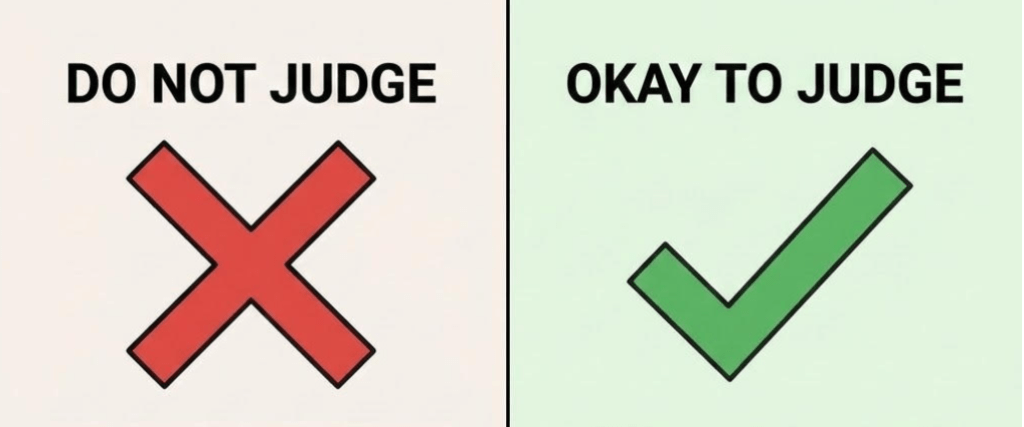
There is arguably no scriptural phrase more frequently quoted—or more commonly misapplied—than Jesus’ command: “Judge not, that you be not judged.” In our modern, pluralistic, and highly sensitive culture, these three short words have become the ultimate conversational trump card. Whenever someone attempts to point out a fault, question a behavior, or draw a moral boundary, the immediate defense is often, “Don’t judge me!” or “You’re not supposed to judge!” The phrase is used to slam the door on all forms of moral critique and correction, effectively creating a “safe space” for questionable actions to go unchecked.
This application is especially prevalent within Christianity, where many believers have adopted a kind of religious hands-off approach, believing that “judge not” is an absolute, universal prohibition against evaluating or correcting the moral and scriptural behavior of others. But does the Bible truly teach a blind, non-discerning acceptance of all actions? The answer, biblically and practically, is a resounding no. The Bible does not forbid all judgment; it forbids a specific type of judgment, while simultaneously commanding us to exercise another: righteous judgment.
The Misquoted Command and Its Context.
The command, “Judge not, that you be not judged,” is found in Matthew 7:1. Taken in isolation, it sounds like a total ban on all moral evaluation. However, the first rule of biblical interpretation is: context is king. If you read the verses that immediately follow (Matthew 7:3–5), the true meaning becomes crystal clear: “Why do you see the speck that is in your brother’s eye, but do not notice the log that is in your own eye? Or how can you say to your brother, ‘Let me take the speck out of your eye,’ when there is the log in your own eye? You hypocrite, first take the log out of your own eye, and then you will see clearly to take the speck out of your brother’s eye.” Jesus is not prohibiting evaluation; he is prohibiting hypocritical judgment. He is reproving the person who is morally blind to their own massive sin (“the log”) but is quick to condemn their brother for a minor fault (“the speck”). The goal of this passage is not to make us incapable of seeing the speck, but to make us capable of seeing it clearly, which requires dealing with our own sin first. In fact, the passage explicitly states the ultimate purpose: “…and then you will see clearly to take the speck out of your brother’s eye.” The corrected self is then prepared and commanded to help correct the brother. I think it is also important for us to note that the context is highlighting behaviors we observe and not those we “heard” through the grapevine.
The Biblical Command to Judge Righteously.
To confirm that the Bible not only allows but requires a form of judgment, we need only turn a few pages. Jesus himself provides the definitive clarification of the type of judgment we need to exercise. In John 7:24, Jesus says, “Do not judge according to appearance, but judge with righteous judgment.” This single verse synthesizes the entire Christian approach to moral discernment. It is a dual command: stop judging superficially or hypocritically, and start judging based on God’s revealed truth—His word.
The Apostle Paul further makes it clear that righteous judgment is an essential function of the local church. In 1 Corinthians 5, the church at Corinth was tolerating a man involved in scandalous sexual immorality. Paul is not passive; he sharply rebukes the church for its inaction and commands them to judge the matter: “I wrote to you in my letter not to associate with sexually immoral people… For what have I to do with judging outsiders? Is it not those inside the church whom you are to judge? God judges those outside. Purge the evil person from among you” (1 Corinthians 5:9, 12-13). Paul explicitly delegates the responsibility of judging moral matters—which includes doctrine, lifestyle, and behavior—to the church leadership and its members. If Christians were forbidden from judging, Paul would have simply said, “Leave the man alone, for we cannot judge him.” Instead, he says the exact opposite.
Other Examples Requiring Discernment =
- Matthew 7:6: Jesus warns, “Do not give dogs what is holy, and do not throw your pearls before pigs.” This requires a judgment (a discernment) about who is who and what is appropriate.
- 1 Corinthians 6:2–3: Paul rebukes the Corinthians for not judging disputes among themselves: “Do you not know that the saints will judge the world? And if the world is to be judged by you, are you incompetent to try trivial cases? Do you not know that we are to judge angels? How much more, then, all about life?”
- Galatians 6:1: “Brothers, if anyone is caught in any transgression, you who are spiritual should restore him in a spirit of gentleness.” You cannot restore someone unless you first judge that they have been “caught in a transgression.”
The Heart of Righteous Judgment.
So, what is the difference between the judgment Jesus forbids and the judgment He commands?
Forbidden Judgment (Condemnation): This is the “log-in-your-eye” judgment.
- Motive: Pride, hypocrisy, spite, or self-righteousness.
- Standard: A different, often stricter, standard than you apply to yourself.
- Outcome: To tear down, condemn, shame, or punish. It usurps God’s final authority.
Commanded Judgment (Discernment and Correction): This is the “seeing-clearly-to-remove-the-speck” judgment.
- Motive: Love, restoration, humility, and protection of the church.
- Standard: God’s unchanging Word (Scripture).
- Outcome: To lovingly restore a brother or sister, protect the holiness of the Christian community, and ensure purity of doctrine.
Righteous judgment is never a license for meanness. It is a spiritual discipline performed in the spirit of Galatians 6:1—gentleness. It demands wisdom, self-awareness, and a deep commitment to the spiritual well-being of the person being corrected.
An Exhortation to Apply Scripture Rightly
When someone automatically uses “Judge not!” to silence correction, they are basically misunderstanding (intentionally or unintentionally) the biblical call to Christian discipleship. The Christian life is not lived in a vacuum; it is a commitment to community, accountability, and mutual holiness. The health of any church is directly tied to its willingness to exercise righteous judgment. If we refuse to judge matters of sin and doctrine within the church: (1) Sin is allowed to fester, which harms the individual and potentially influences others (1 Corinthians 5:6). (2) We fail to demonstrate love, as true love requires speaking the truth, even when it is difficult (Ephesians 4:15). (3) The integrity of the Gospel is compromised, as the church ceases to look distinct from the world.
Therefore, let us stop using “Judge not” as an excuse for spiritual indifference or fearfulness. Let us embrace the difficult, necessary task of judging righteously. This means:
- Examining ourselves first: Deal with the log in your own eye before helping with the speck in your brother’s. If you can’t do this, then you’re not ready to speak into anyone’s life.
- Using Scripture as the standard: Our personal opinions are irrelevant. We must judge all matters against the unchanging truth of God’s Word.
- Speaking in love: The goal is always restoration, never condemnation. The words must be true, but the tone must be gentle and humble.
As much as we don’t like it, let’s be the first ones to accept judgment and criticism with humility. When we are able to do this well, we will have the right heart posture to judge and speak the truth in love. Learning to judge rightly is an act of spiritual maturity and a key to maintaining the purity and power of the church. As we grow together in this, may we be a people who fear God more than we fear being accused of “judging.” “For am I now seeking the approval of man, or of God? Or am I trying to please man? If I were still trying to please man, I would not be a servant of Christ.” (Galatians 1:10)


Leave a Reply